
At Consilium, we’ve built our agency with three key functions that work together – like the keystone in an arch – to give you unrivaled support.
Read on to discover how the Keystone Model serves our clients and providers (and why they prefer it over other methods).
What is the Keystone Model?
A keystone is the last stone placed in an arch that locks all the other stones into place.
In other words, it’s what makes the arch work.
In locum tenens, the Keystone Model divides work processes into three distinct modes of operation that collaborate to support facilities and providers alike. For example:
- Client services
- Recruiting
- Account management
Each piece represents not just a different type of work but a completely different mindset and environment optimized for specific types of tasks.
Drawbacks of traditional work models
It’s common for locum tenens organizations to divide this work into two functions instead of three. This two-person team builds facility and provider relationships, recruits healthcare staff, and manages placements—often simultaneously.
Seems efficient: fewer handoffs, better continuity, leaner operations.
However, this also means that staff are constantly toggling between stakeholders and tasks, producing placements that lack the precision and quality that other models enable.
The Keystone Model offers a solution that works with the complex realities of locum tenens, instead of against them.
Consilium’s approach
Rather than taking a generalist approach, our model looks like this:
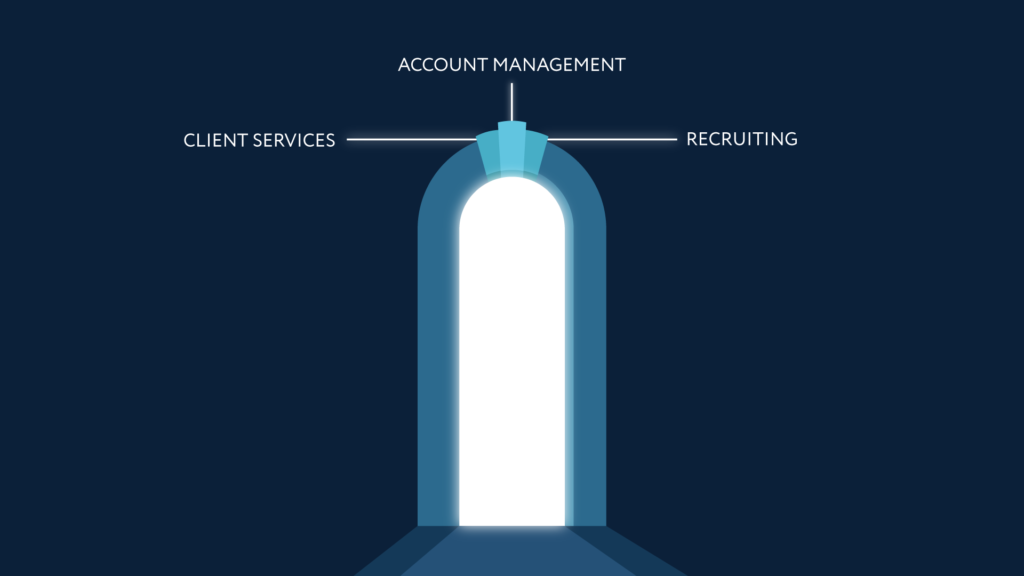
Because there are so many savvy healthcare professionals with stakes in this game, it’s important to us that everyone feels heard and has their needs met. So, we use the Keystone Model.
1. Client Services: Understanding facility needs
Our client services department focuses on healthcare facilities, building relationships to understand and advocate for your staffing needs and overall goals.
These facility experts concentrate on establishing a point of contact for healthcare organizations in their designated geographic area. This specificity lets them dig deep into what communities need, making it easier to find the best fit quickly and efficiently.
As a function, client services has the space to establish quality relationships with the people at each facility, a quality of care that can’t be overstated.
2. Recruiting: Sourcing ideal candidates
Recruiting works with healthcare professionals, getting to know who you are, your job preferences, and helping you practice medicine the way you’ve always wanted.
Through focusing on a particular specialty, our recruiters get to know the ins and outs of your precise skillset, allowing them to better understand your capabilities as well as your preferences.
Recruiters have access to tons of diverse locum tenens roles in all kinds of locales, and are dedicated to help place you exactly where you want to be – in both your career and in the country.
3. Account management: Ensuring placements run smoothly
Account management is our best-fit champion. Their role is to ensure that both provider and facility are comfortable with their mutual decision, and ensure that everything goes smoothly from travel and lodging to community care.
Your manager will help you coordinate interview times, candidate notes, job details, and everything in between.
Once you’ve made a match, your account manager acts as your point of contact throughout the entire placement. From coordinating with our Travel and Payment Concierge departments to answering any questions that pop up, account managers help ensure that you have the best possible experience.
Final Thoughts
By allowing each department to focus on what they do best, we deliver better results for healthcare facilities, better experiences for healthcare professionals, and ultimately better care for patients. It’s our keystone that makes the whole thing work.